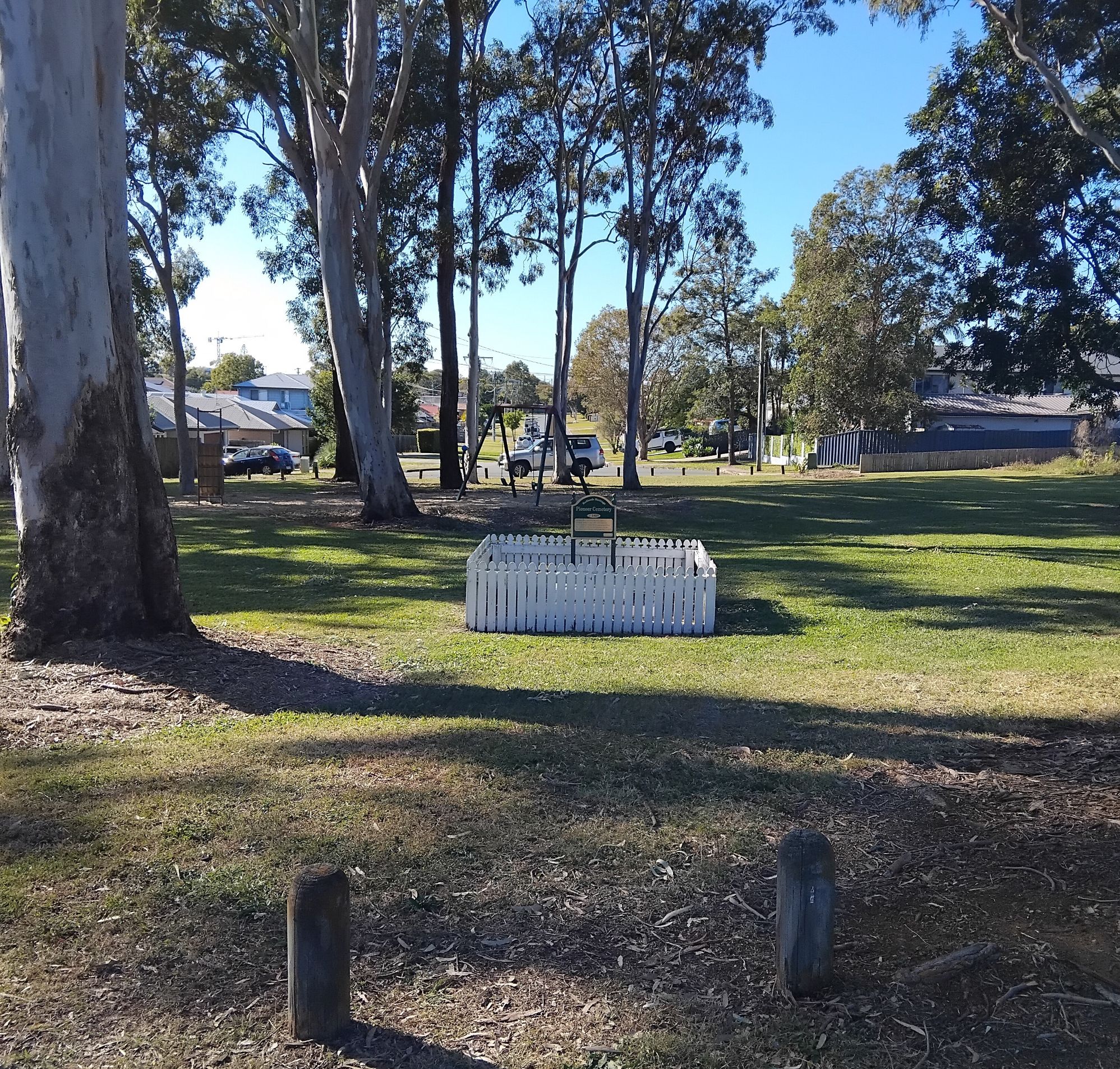
On a quiet, green patch of parkland in Cleveland, children play and residents take a stroll in the winter sun – unaware that under their feet sits some of the earliest chapters of European settlement on Redlands Coast.
It is here, in the unassuming Scott Street Park, that the Cleveland Pioneer Cemetery, also known as Cleveland No.1 Cemetery, once served as the final resting place for the district’s first settlers.
Listed on the Queensland Heritage Register since 18 September 2009, the site is both modest and deeply significant. With no headstones left to mark its history, its story must instead be pieced together through records, memory and the landscape itself.
Before Cleveland became a bayside suburb, it was a hopeful frontier town. Following the closure of the Moreton Bay penal settlement in 1842, the region was among the first in south-east Queensland opened to free settlers. Its coastal location made it a serious contender as the principal port for the district.
By 1850, Cleveland had been declared a township. Land sales followed soon after, attracting farmers, timber-getters, businesspeople and shipping interests. The small but growing community needed essential infrastructure – including a cemetery.
In December 1858, surveyor H. Rawnsley laid out Cleveland’s first burial ground on land bounded by Wellington, Queen, Russell and Smith streets. Reflecting the societal norms of the time, the cemetery was carefully divided into denominational sections –Anglican, Presbyterian, Wesleyan, Roman Catholic, Jewish, and “various denominations”.
Yet, despite its orderly design, nature had other plans.
The site quickly proved problematic. Built on low-lying, swampy ground, the cemetery was increasingly deemed unsuitable. Burials were few – at least 11 are known between 1858 and 1873, with some reports saying as many as 25 – but conditions were far from ideal.
Among those buried there were Bridget Clary, a young child; fisherman J. Neale; publican William Rae; and blacksmith Andrew Whelan.
Most notable among them was Arthur Sidney Lyon, a pioneering journalist often called the “Father of the Queensland Press”, who died in 1861.
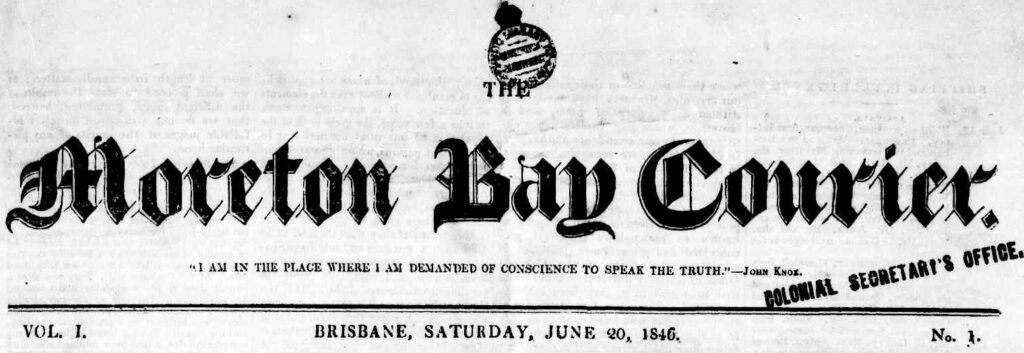
Lyon established the Moreton Bay Courier – which later became The Courier-Mail – with partner James Swan. Its first edition (pictured below) was on 20 June 1846, with Lyon apparently resigned as editor in December of the following year following arguments with Swan.
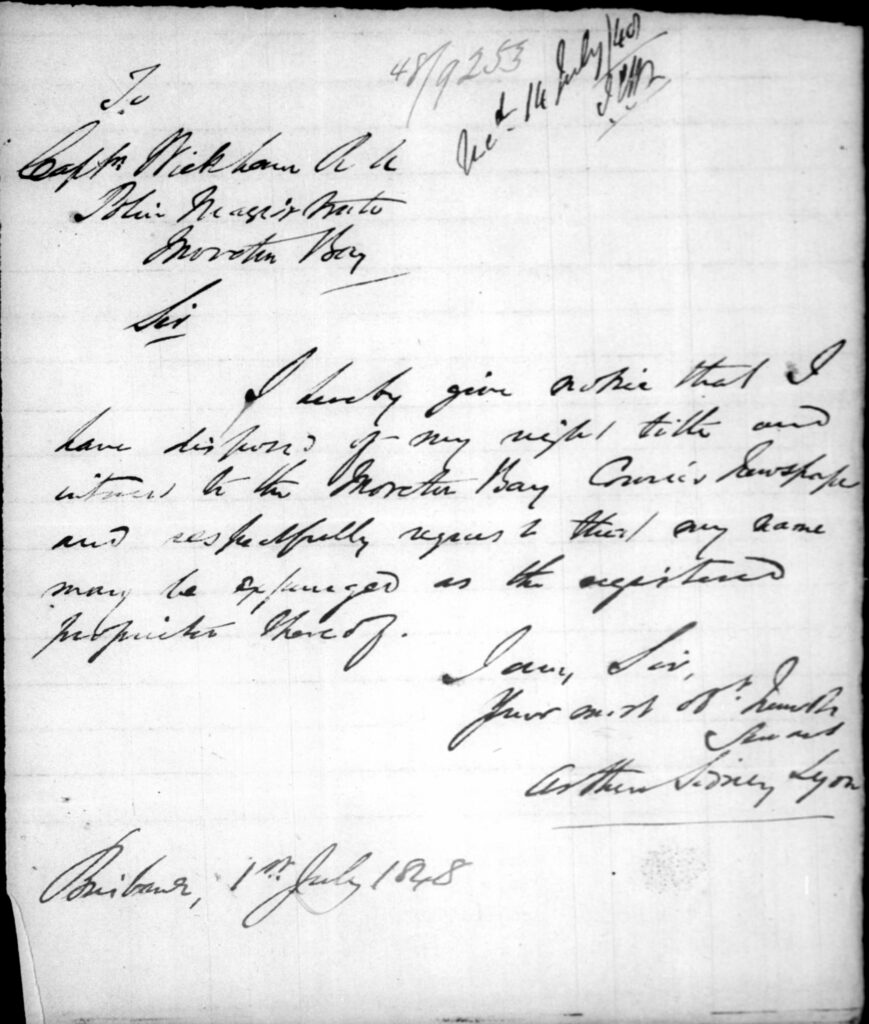
In 1848, Lyon wrote to the Colonial Secretary of the British Colony of New South Wales relating to the Moreton Bay settlement, noting that he was “giving notice of disposal of rights to title and interest to ‘Moreton Bay Courier’ newspaper – no longer registered proprietor” (letter pictured below).
From then, Lyon went on to establish and run the Moreton Bay Free Press from 1849 to 1855, the Northern Australian in Ipswich from 1855 to 1858, followed by the Darling Downs Gazette from 1858, presumably until his death in 1861.
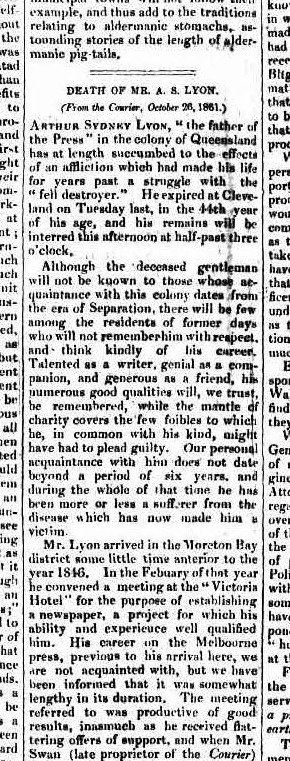
His obituary in the Moreton Bay Courier on October 26, 1861, started with the following lines: “Arthur Sidney Lyon, the ‘father of the Press’ in the colony of Queensland, has at length succumbed to the effects of an affliction which has made his life for years a struggle with the ‘fell destroyer’. He expired at Cleveland on Tuesday last, in the 44th year of his age, and his remains will be interred this afternoon at half-past three o’clock.”
A dozen years on from Lyon’s passing, the decision was made to abandon the Cleveland No.1 Cemetery site. A new cemetery – ingeniously named Cleveland No.2 Cemetery – was established on more suitable ground nearby. Whether the original burials were ever relocated remains a mystery.
Over time, the first cemetery faded from view and public consciousness. Headstones disappeared, records remained incomplete, and the land was gradually absorbed into the expanding township.
Yet, the community never entirely forgot.
As early as 1905, local authorities objected to the sale of the former cemetery land, arguing that burial grounds should not be alienated. Further objections followed in 1924 and 1937, reflecting a lingering respect for those interred there. Eventually, the site was formally reserved as a cemetery space in 1937.
It wasn’t until 1975 that a visible memorial returned the cemetery to public awareness. In an act of community history-making, Cleveland State School teacher Merv Beitz and his students erected a memorial stone listing 10 known individuals buried at the site. With no remaining grave markers, it became the only physical tribute to those early settlers.
Today, Scott Street Park is a landscaped suburban space that is maintained by Redland City Council, but historians and archaeologists believe the site may still contain subsurface evidence of graves, offering insight into burial practices, social structures and settlement patterns in early Queensland.
The layout could reveal how closely reality matched Rawnsley’s original cemetery plan. It may also answer lingering questions about whether some graves were later moved.
In a broader sense, the cemetery represents a rare opportunity to better understand life – and death – in Queensland’s early regional communities. The arrangement of graves, the materials used, and even the number of burials could shed light on class, religion and demographics at a formative time in Redlands Coast’s history.
Long before European settlement, the area was part of the traditional lands of the Quandamooka People, whose deep cultural connections to the region continue today. The cemetery is just one layer in a much longer human history of the land.
That layered past is part of what makes the site so compelling. It is not simply a cemetery, nor just a park, but a place where stories overlap – Indigenous heritage, colonial ambition, community memory and modern suburban life.
Unlike many historic cemeteries, there are no headstones to wander among at Cleveland No.1. No dates carved in stone, no epitaphs to read. Instead, remembrance here relies on imagination, interpretation and respect. Framed with a low white picket fence, the memorial stone stands quietly, a reminder of names that might otherwise have been lost altogether.
In a rapidly growing region, spaces like this offer something rare: a connection to origins. Not grand or dramatic, but deeply human – the lives of ordinary people building a new community, and the traces they left behind.
So next time you pass through Scott Street Park, pause for a moment. Beneath the grass and playground laughter lies a forgotten cemetery, and with it, the earliest stories of Cleveland – still waiting to be uncovered.
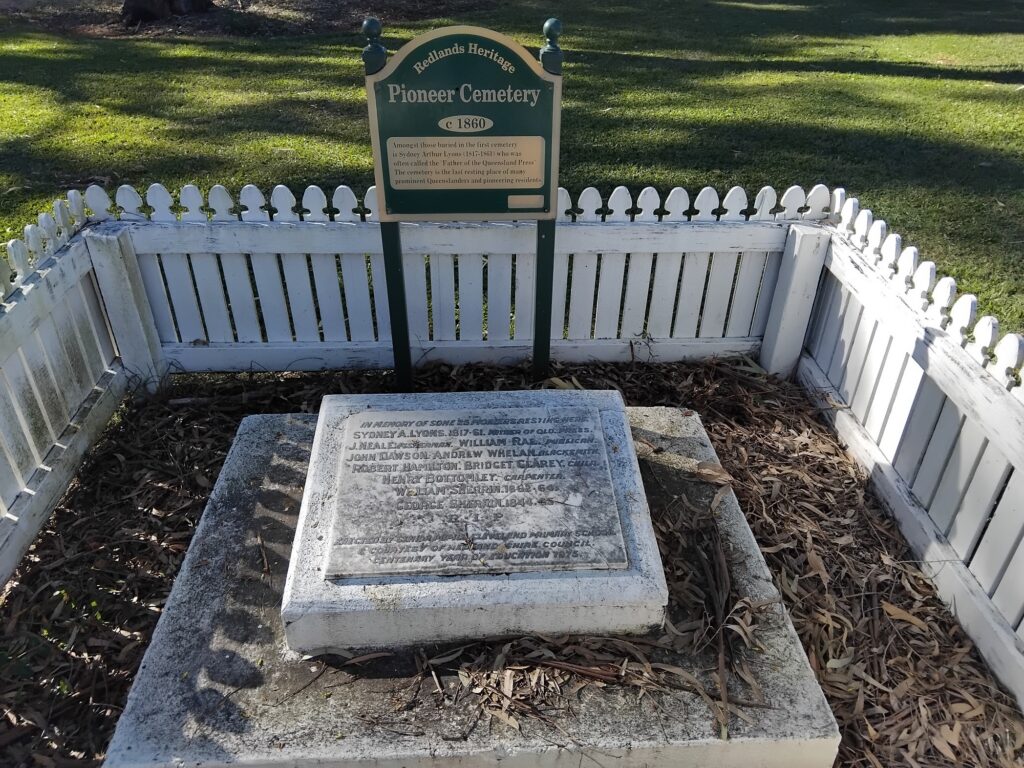
The Cleveland Pioneer Cemetery memorial plaque reads:
In memory of some 25 pioneers resting here.
Sydney A Lyons. 1817–61. Father of Qld press.
J. Neale. Fisherman.
William Rae. Publican.
John Dawson.
Andrew Whelan. Blacksmith.
Robert Hamilton.
Bridget Clarey. Child.
Henry Bottomley. Carpenter.
William Sherrin. 1862–64.
George Sherrin. 1844-66.
R.I.P.
Erected by senior pupils, Cleveland Primary School & courtesy of Redland Shire Council. Centenary Year of Education 1975.
Interesting to note:
- Records show that Emily (Amelia) Hobbs, who died 28 July 1860, is also buried at Cleveland No.1.
- Arthur Sidney Lyon being written as Sydney A Lyons was one of several misnamings found in historical records relating to Lyon.
- William Sherrin was only aged 1 when he died, with his older brother George, 22, dying two years later.
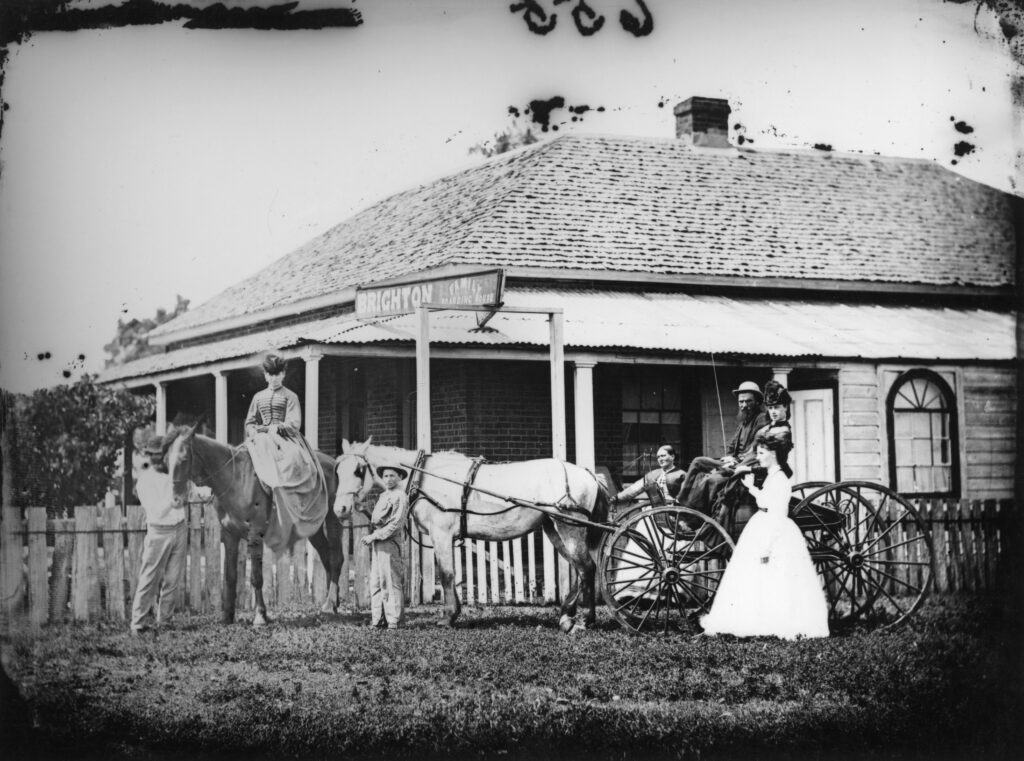
- William Rae was the publican at the Brighton Hotel (now Grand View Hotel) on Cleveland Point. In 1862, Rae leased the hotel which at the time boasted its own bathing house and jetty.