
The following is an edited extract from Redlands Coast History: Redlands at War from the Redland City Council Libraries: Local History Collection.
It was the Cleveland train that brought the news to the Redlands via the newspapers of the day – “Australia supports Britain’s declaration of war against Germany,” they declared.
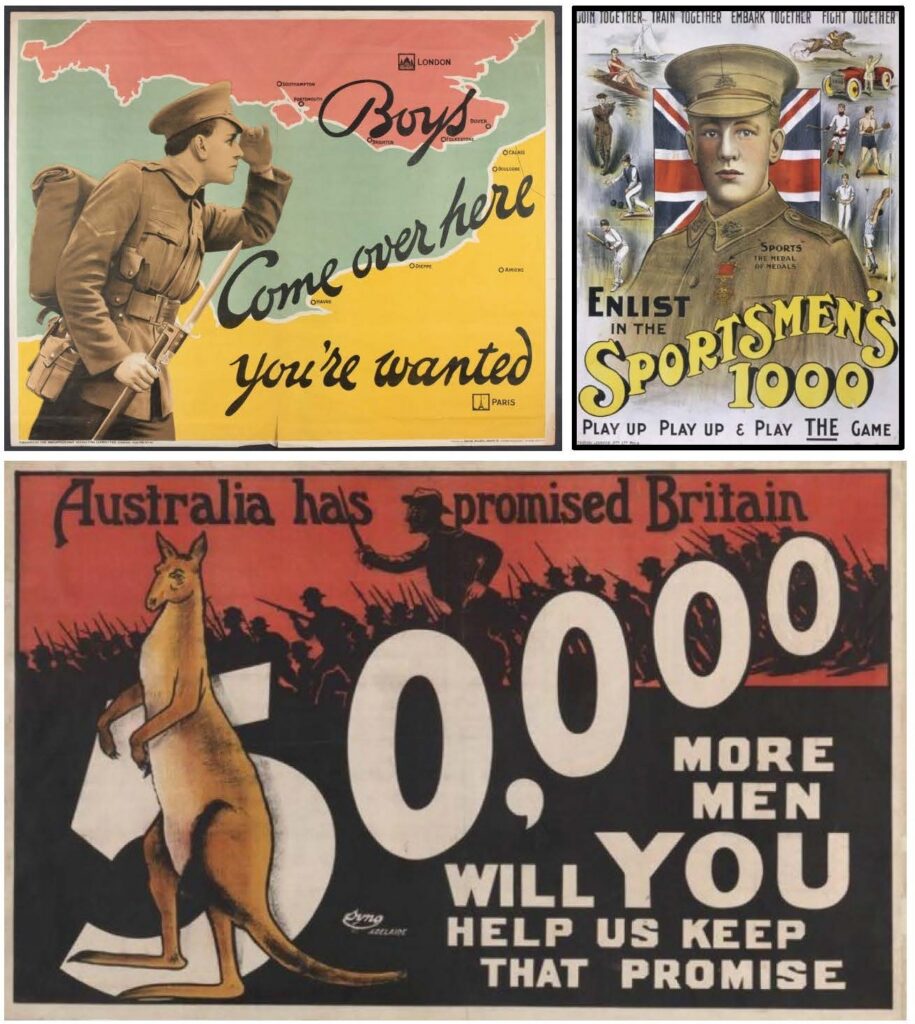
In what was the first few days of August 1914, the Australian Fleet was being readied for active service. Prime Minister Joseph Cook gave a stirring speech that included: “If the old country is at war, so are we.” An outburst of patriotic fervour later erupted in Brisbane when the Honourable William Kelly declared: “We are bone of Britain’s bone and blood of Britain’s blood.”
The Queenslander reported on 24 August 1914: “Yesterday proved a busy day at Victoria Barracks, Brisbane when the enrolment of volunteers in connection with the Queensland section of the expeditionary force was proceeded with. In the morning there was a rush of volunteers wishing to enlist and throughout the day the cottage in Blackall Street, Petrie Terrace, where the medical inspection took place, was besieged with applicants. The men enlisted were of a fine stamp, chiefly between about 20 and 40 years of age, the majority of whom had military experience to their credit.”
Although the battlefields and major historical events of the Great War (only later known as World War I) were occurring on the other side of the world, the effects reached around the Commonwealth.
The impact of the war was felt across the whole Redland community and through generations of its families. Fathers and sons were lost, and those who returned felt the repercussions of war for decades to come.
In August 1914, after giving its support to Britain’s declaration of war, troops were sent to Egypt when the Ottoman Empire (Turkey) threatened British interests in the Middle East and Suez Canal.
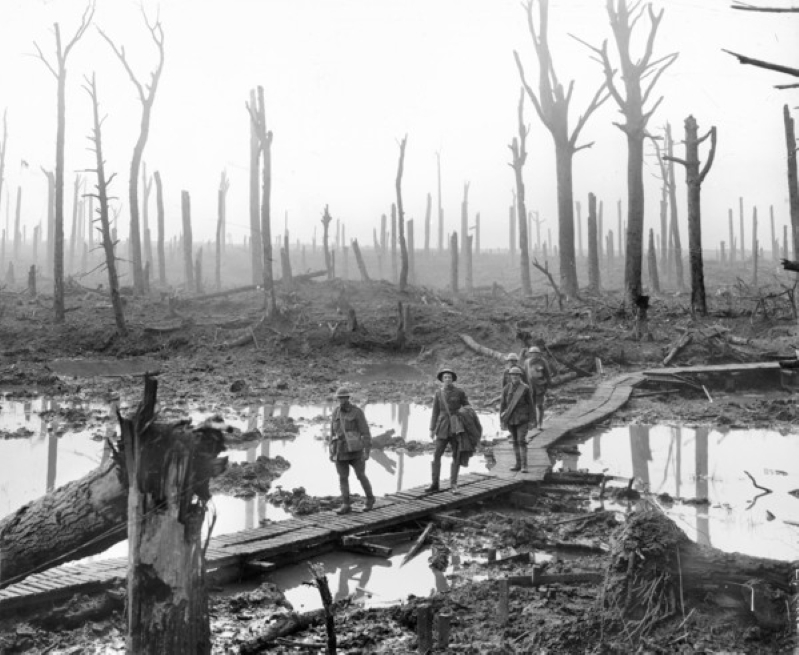
A month later, the Australian Naval and Military Expeditionary Force took possession of German New Guinea. It was April 1915 when Australian Infantry Force troops landed at Anzac Cove, Gallipoli. They were evacuated in December.
Armed volunteers were essential for Queensland’s early defences, and many rifle ranges were established to give them an opportunity to refine their skills. Hilliards Creek in Cleveland was chosen as the area for an official rifle range and it was opened on 3 July 1915. Additional targets were installed in 1916.
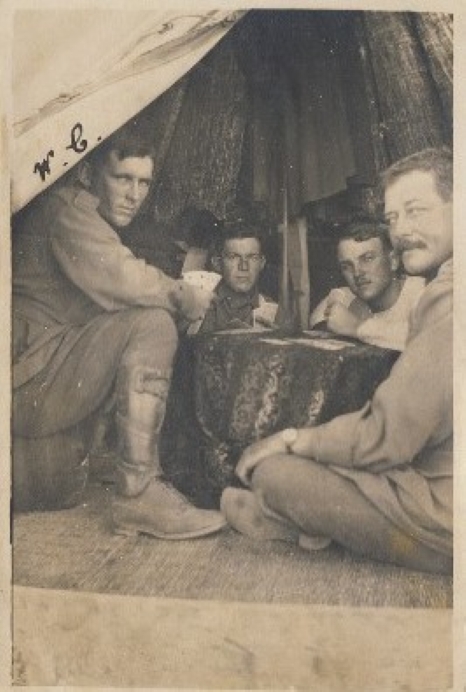
On the home front, Redland Coast residents were doing their part in the war effort. One notable pursuit was the ‘knitting socks for soldiers’ campaign.
A pair of hand-knitted socks was more than just a comfort from home for soldiers in the trenches of Europe, they also helped protect against fungal infection. Trench foot, caused by prolonged exposure of the feet to damp, cold and squalid environments, was rampant and it was recommended that trench soldiers change their socks at least twice a day.
The call went out and across the Commonwealth, the knitters got knitting to build up a steady supply of socks. In Australia, organisations such as the Red Cross and Australian Comforts Fund distributed patterns and provided access to cheap wool, and it’s estimated that Australian knitters – predominantly women and schoolchildren – produced over a million pairs for the troops at the front.
These State Library of Queensland photos (below) taken in July 1916, show the “Campbell women on an excursion to Redland Bay” as they patriotically got knitting.
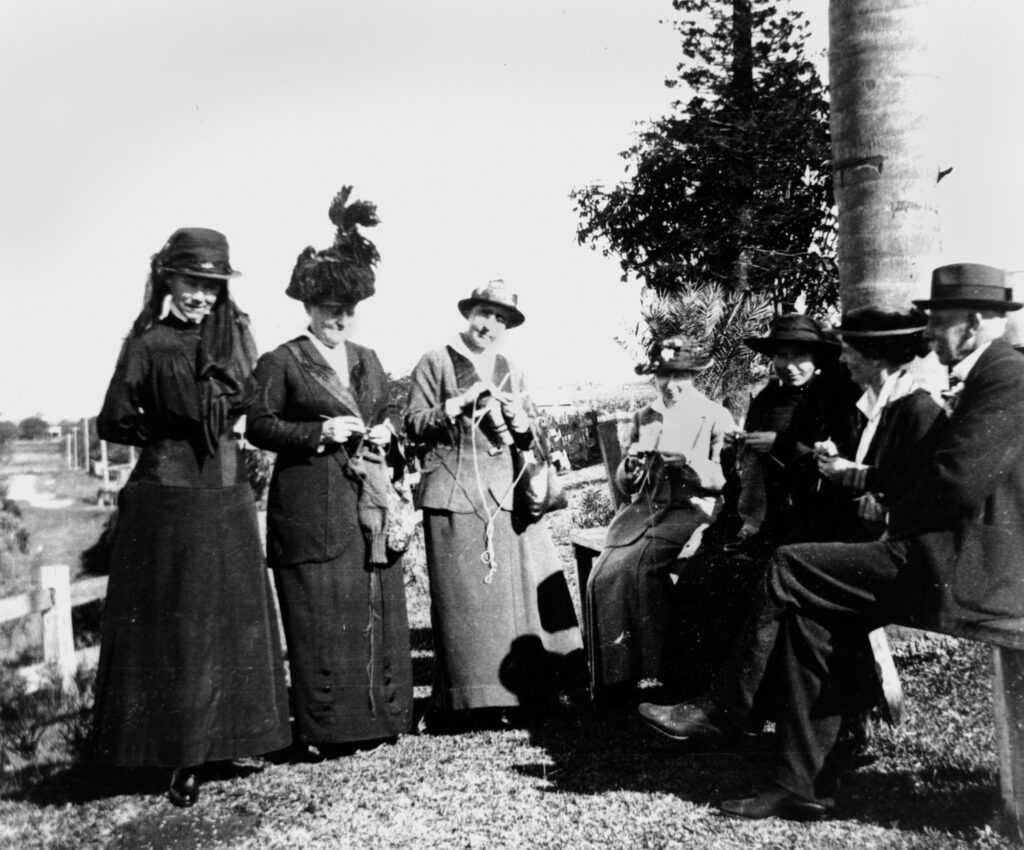
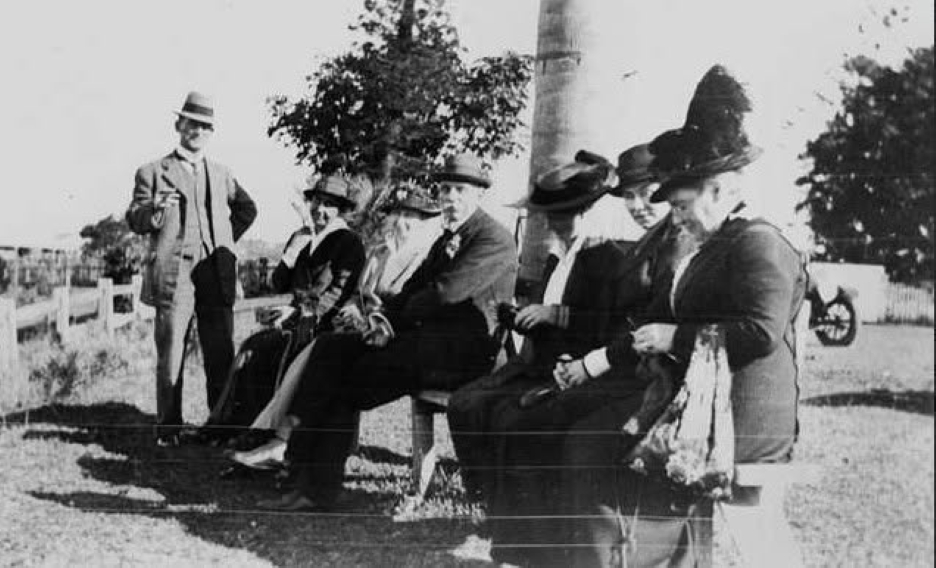
The Great War hostilities officially ended with the signing of the armistice between the Allies and Germany near Compiègne, France, on 11 November 1918, but the shadows stretched on for decades, as did the call that “we shall never forget them”.
After the demobilisation of the forces, two sub-branches of the Returned Soldiers’ and Sailors’ Imperial League of Australia (RSSILA) were formed. In 1919, one sub-branch was established at Redland Bay which was in the Tingalpa Shire, and one in Cleveland.
Each sub-branch was responsible for the erection of the Memorial Stone in that area, as well as their respective Rolls of Honour.
The idea of a memorial for the district’s residents who had served in war had been raised during the Great War, when local residents canvassed the matter with the then Cleveland Shire Council. Initial suggestions included planting shade trees along the roads and naming them after fallen soldiers. This suggestion was declined as the Council had already resolved to eventually build a permanent memorial to the fallen. A series of public meetings were held in the Cleveland Shire to discuss the location of its memorial, but the decision was postponed until the end of 1919.
The suggestions put forward basically agreed that a stone monument should be erected embracing the whole Cleveland Shire, preferably in a prominent place near the centre of the Shire. Cleveland Shire included Thorneside, Birkdale, Wellington Point, Ormiston, Cleveland and Thornlands. The remainder of what has been Redland Shire/City since 1949 was still at that time a part of the now defunct Tingalpa Shire.
Several possible sites for the Cleveland memorial were suggested, with two in Cleveland and one in Wellington Point. Shortly after these meetings, the Cleveland Shire Council unanimously voted that “one memorial stone, in the form of a broken column be erected for the Shire” It also resolved to erect the memorial stone in the triangle of land at the south-east corner of the intersection of Shore and North streets, east of Passage Street, Cleveland.
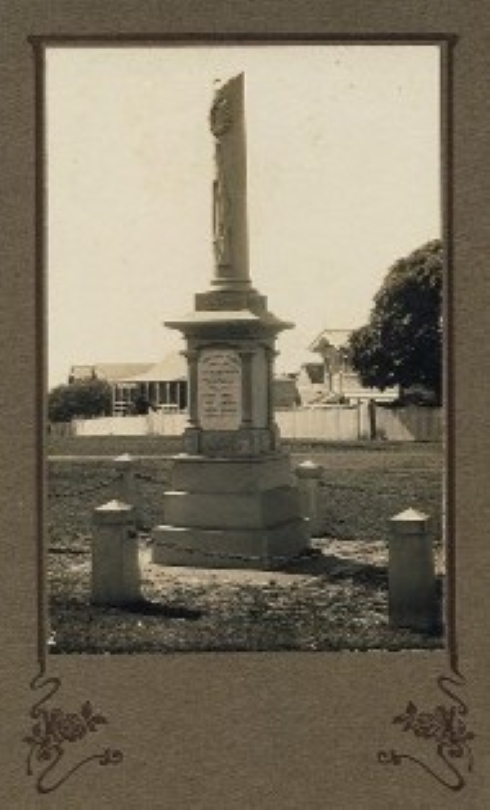
The Cleveland Memorial was built by W E Parsons of Brisbane, whose design was approved by the Cleveland Shire Council and was described as: “including 8 stone posts 3 feet high & iron chains painted bronze green, brown Helidon freestone to be used.” It also included a list of the names of the fallen. The Memorial was delivered to Cleveland and erected in early August 1920 and officially unveiled on Saturday 14 August 1920.
With help from the Redland Bay sub-branch, local returned soldiers raised funds through drives and appeals to contribute to the construction of the Redland Bay Cenotaph (Roll of Honour) on which fallen soldiers were memorialized.
The cenotaph was built in 1923 with the official unveiling held on July 1. General Spencer Browne performed the unveiling and said the memorial served as a testimony to those who served and a “tribute from devoted and grateful hearts”.
The Cenotaph is believed to have been constructed by Andrew Petrie and was originally on the corner in Weinam Street, before being moved to the southern end of Neville Stafford Park in 2005.
With the district being part of the Tingalpa Shire until 1949, the full Roll of Honour for soldiers from Redland Bay and surrounding areas can be found on the Tingalpa Shire Roll of Honour board in the Mount Cotton Community Hall, close to the old site of the Tingalpa Shire offices.
By 1925, the RSSILA had been renamed Returned Soldiers’, Sailors’ and Airmen’s Imperial League of Australia (RSSAILA).
The Redlands RSSAILA Sub-branch held its first meeting on 11 May 1925. At its July meeting the Sub-branch decided to build a memorial hall. The land was purchased in 1926 and fund-raising began for the building which was completed in 1928 on the north-west corner of Passage and Shore streets. The hall was opened by Queensland Premier S M Bruce.
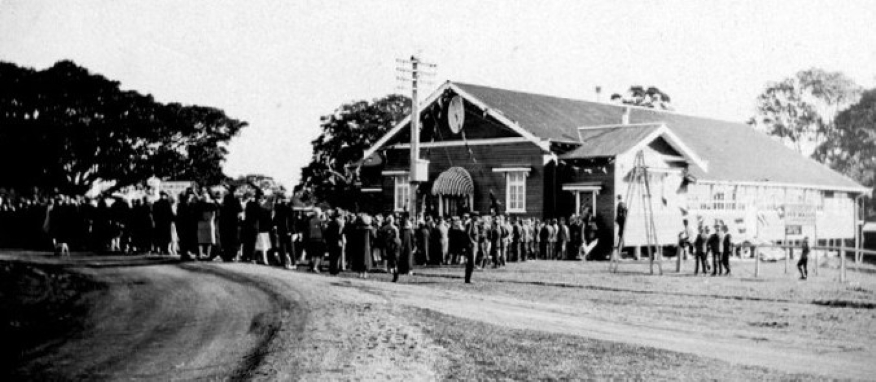
Six years later Prince Henry, the Duke of Gloucester attended a civic reception held there in his honour. The Duke also inspected local farm produce in the district.
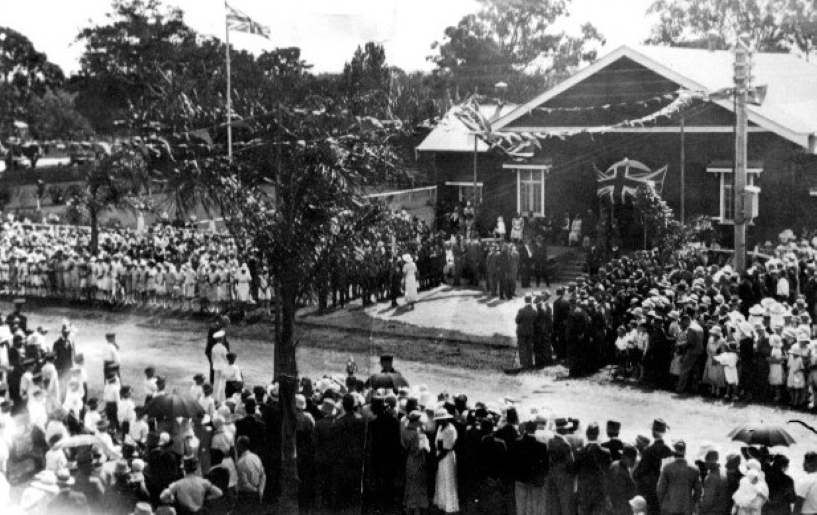
The RSSAILA (RSL) Memorial Hall also known by locals as the Cleveland Memorial Hall became an important landmark and over the years it hosted many activities, including fetes, charity functions and balls. It also housed a library and a kindergarten as well as a playground and a green for ring bowls outside.
In the years following the Great War, many returned soldiers suffered from what we now know to be Post Traumatic Stress Disorder (PTSD). Sadly, some turned to drink and other destructive ways of dealing with their demons and ended up becoming homeless. The Dunwich Benevolent Asylum housed these mostly unwanted men from all over greater Brisbane, many of whom ended up in unmarked pauper’s graves. Although there are only a few hundred obvious gravesites in the Dunwich Cemetery, following a ground penetrating radar (GPR) survey, it is believed that nearly 10,000 people are buried there.
Remembrance Day on Redlands Coast
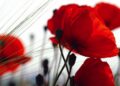
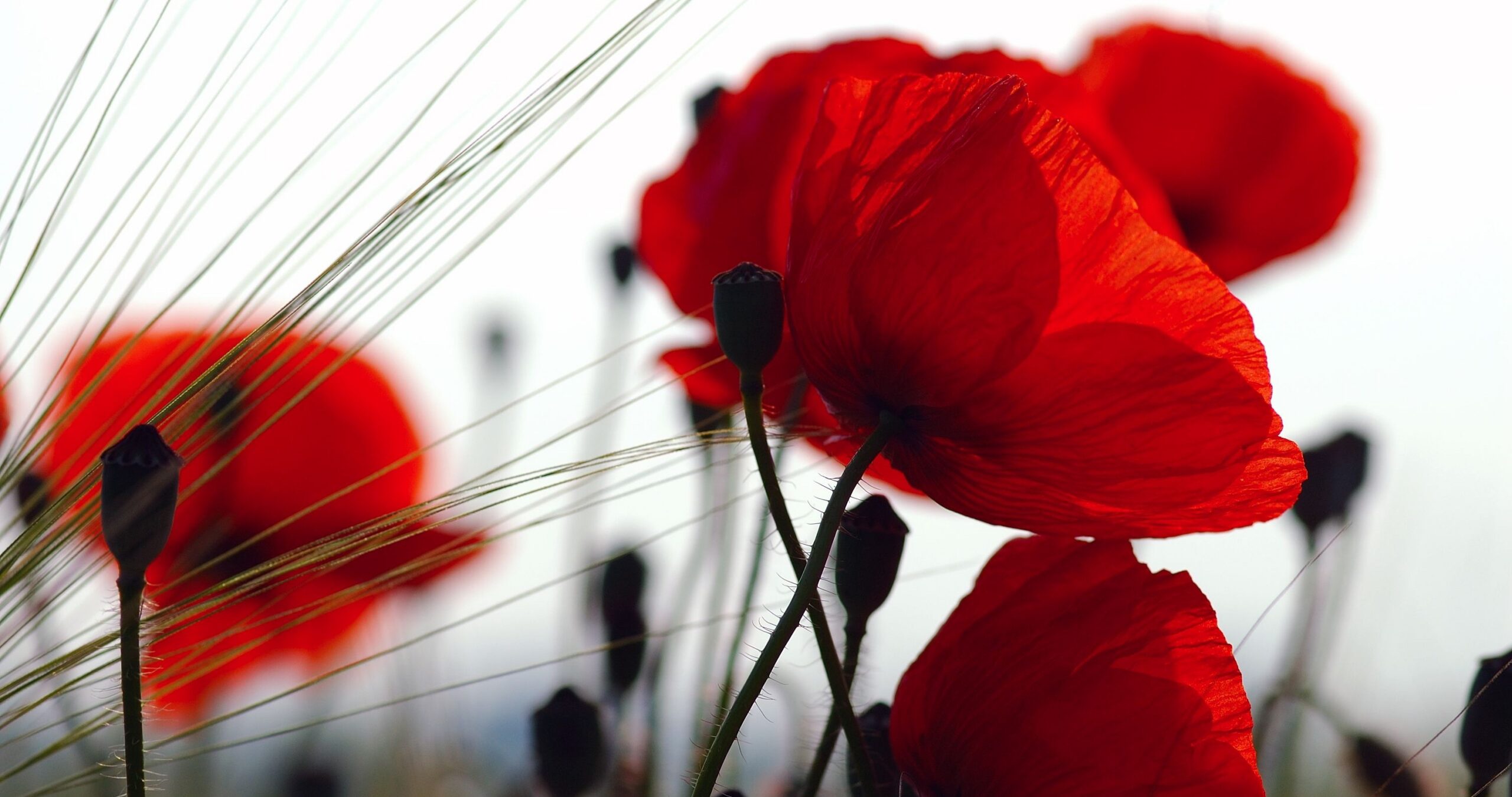
11 November marks the anniversary of the Armistice that ended fighting with Germany in World War I. Every year since 1919, many nations have paused on Remembrance Day in memory of their fallen service people. The red poppy is a symbol of remembrance of those who died or suffered in wars, conflicts and peacekeeping operations. At the 11th hour of the 11th day of the 11th month, Redlands Coast will pause for a minute of silent reflection in memory of those who died while in military service. Commemorative services will be held across the city, see the RSL Queensland listings here
More resources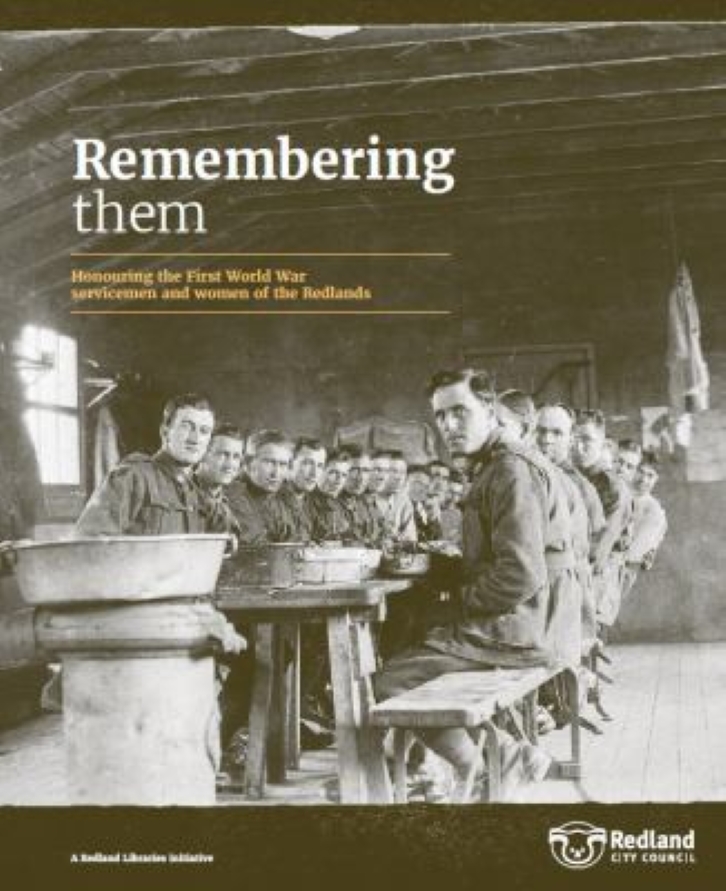
In 2018, Council published a comprehensive book honouring those who served. Remembering them: Honouring the First World War servicemen and women of the Redlands is available through Redland City Council Libraries.
To find more information about war-time Redlands Coast, search in the library catalogue via the Library Catalogue: Redlands Coast History link or by clicking on the Libraries or Discover Redlands Coast link on the Redland City Council website (redland.qld.gov.au) and following the links to Local History.