
The following is an edited extract from A Local History Mystery: The Legend of the Spanish Galleon from the Redland City Council Libraries: Local History Collection.
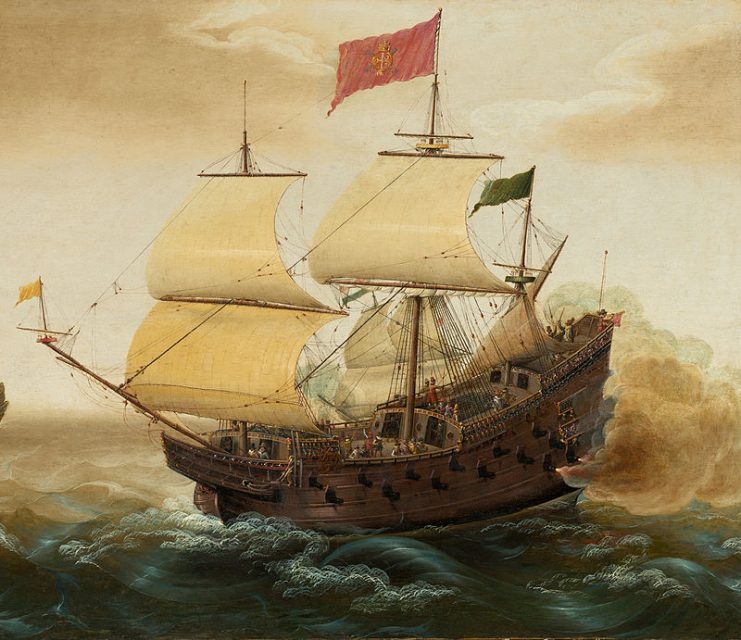
The mystery of the wreck of a Spanish galleon believed to be buried under swamp peat on North Stradbroke Island (Minjerribah) has been a contentious topic for decades.
There are many newspaper articles spanning more than a century that mention a mysterious shipwreck, including one report by a Minjerribah man who claimed to have seen the ship in the 1930s. He was recorded as saying that he remembered seeing a big ship with its mast still attached.
The location for the wreck has been greatly debated, but it is now generally assumed that if the wreck does indeed exist, it is in the vicinity of 18 Mile Swamp which is on the east coast of Minjerribah. It is a vast and impenetrable area.
The swamp is a massive freshwater peat swamp, which is sometimes called a barrier swamp due to the high sand dunes which are situated behind the beach, and which form a barrier. They run parallel with the island, and the swamp traps the freshwater that runs out of the hills behind it.
While people have claimed that the swamp is too far from the coast, it must be remembered that the coastline has undergone significant changes over time.
But what are the origins of this shipwreck legend? How did it all come about?
The story is linked to several people, especially to a man called Greg Jeffreys who wrote the 2015 book The Stradbroke Island Galleon: The Mystery of the Ship in the Swamp which was received with mixed reviews.
Jeffreys was responsible for reigniting public interest in the potential wreck. With a degree with majors in History and Archaeology from the University of Queensland and a master’s degree in history from the University of Tasmania, Jeffreys approaches the myth and his associated research from an academic stance.
According to Jeffreys the location of the shipwreck was once known by only a small handful of people in the 19th century – the First Nations people on Minjerribah and a small group of European cattlemen and timber getters. They guarded the secret closely and it eventually disappeared from living memory.
Jeffreys writes in his book that the few Europeans who stumbled across the wreck helped themselves to the timber and brass fittings from the ship thus gradually reducing the physical remains.
His interest in the wreck was inspired by the stories he’d heard about eyewitness sightings of a mysterious wreck in 18 Mile Swamp.
One source was a Quandamooka woman from Minjerribah who it is said was a descendent of one of the Spanish shipwreck survivors. Apart from the family legend there was also in the family’s possession a small wooden box which contained artefacts such as a handwritten book or journal, some coins, a belt buckle, and some rings – all supposedly the property of a marooned Spanish sailor. Unfortunately, all these items were destroyed when the family home burnt down in the 1980s which does cause obvious issues with validating the story.
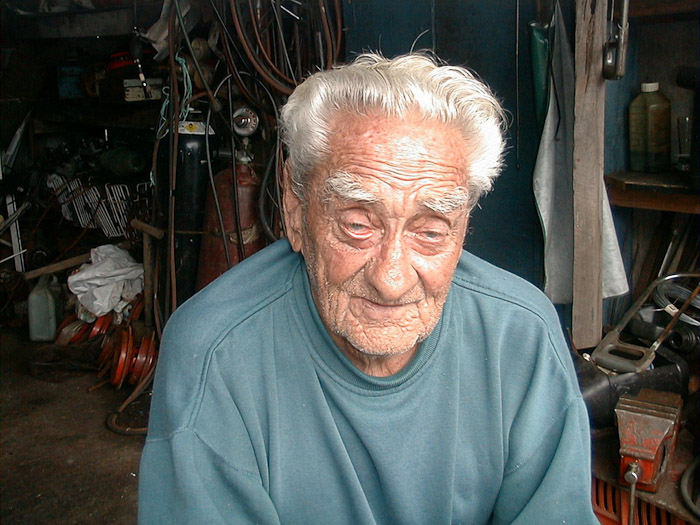
Jeffreys also took inspiration from a story he was told by local man Jim Bryce in 1989. Jim or Jimmy first heard about the wreck in the 1920s and claimed to have seen the wreck of the ship in the swamp later in life while in the employ of a sand mining company. So confident was Jim of the existence of the ship that he was able to point out on a map what he believed was the approximate location of the ship to Jeffreys. Jim described the size of the ship as being 200 feet, which is significant because the typical size of a galleon is 100 – 150 feet.
In an article published in The Courier-Mail in 2007 Jeffreys talks about some of the artefacts that he found on his search for the shipwreck – a brass button, a fishing weight and a sword blade. The blade was described as a rapier blade a style popular in 16th century Spain. The button he claimed was from a similar time, while the fishing weight it was suggested was made by the shipwrecked survivors who used it for fishing primarily because of its crude design.
Dr Harold Young claimed to have found the wreck in 1934, taking from it a sailor’s dirk (dagger), coins and various other artefacts. He was in the company of other Rover Scouts who were using a map drawn by Dr Young’s grandfather.
The article closes with a comment from a curator at the Queensland Museum who says that it is very possible that Jeffreys did see something but why does it have to be of Spanish or Portuguese origin?
Another key figure in the conversation surrounding the galleon shipwreck was a lady called Isobel Hannah. She was something of a Gold Coast identity and at one time was private secretary to Colonial Secretary J.G. Appel.
Hannah moved in very influential circles in the 1920s, ’30s and ’40s, and wrote many newspaper articles. In 1949 she was elected a fellow of the Royal Geographical Society of Australasia in recognition of her work in compiling historical and geographical records of Queensland.
Hannah was instrumental in creating widespread interest in the ‘wreck’ due to her widely read newspaper articles, writing a spate of them on the wreck between February and April 1921. In her article Memories of Amity she mentions people of Spanish descent living on Minjerribah, a theme which Jeffreys also mentions.
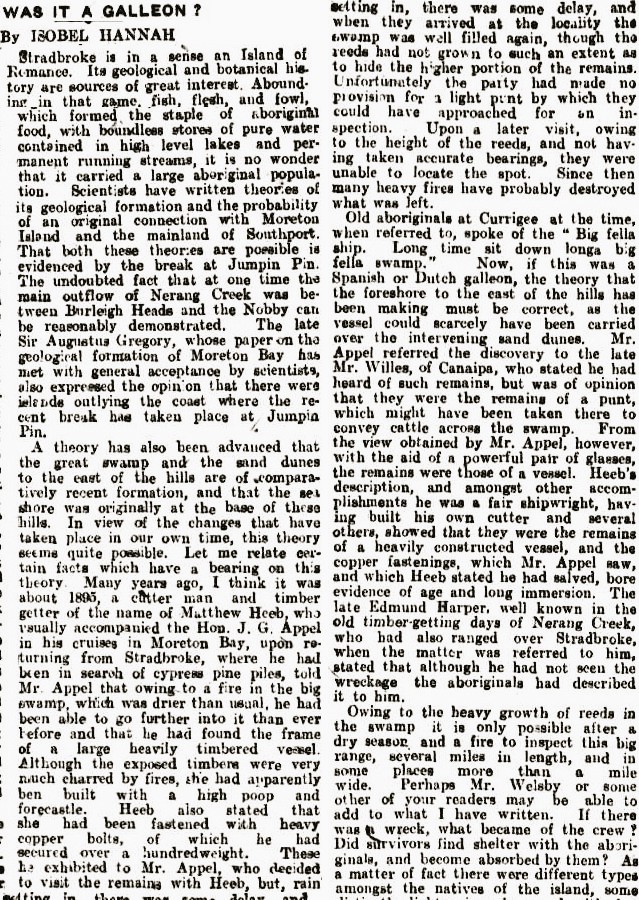
In another article titled Was it a Galleon published in The Queenslander in 1921 (inset right) Hannah writes about the geological and botanical history of Minjerribah, and her observations and experiences while on a visit there. Hannah recounts a tale from 1895 about a timber getter called Matthew Heeb and his encounter with the mysterious ship. Heeb was on the island in search of cypress pine, when he came across 18 Mile Swamp, which had recently been burnt out by a bush fire.
With the swamp suddenly accessible, he ventured into the area and there he found the remains of a large timber vessel. Heeb described the ship as having heavy copper bolts and of having been built with a high poop and forecastle.
When Heeb attempted to return to the site with a party of people, rain had fallen, and the swamp was once again impenetrable, with the reeds obscuring any visible sighting of the remains.
Significantly, Hannah also claimed that the existence of the wreck was confirmed by some of the old pioneers of the district in the 1870s and 1880s, plus she names another eyewitness. Andrew Graham was a ships pilot and lightkeeper out in Moreton Bay on one of the pile lights, who not only knew about the wreck, but who also apparently found a wooden Spanish anchor which he kept on display at his Nerang home before selling it. Hannah also mentions the shifting coastline, and the fact that the ocean would have been closer to the foot of the hills at the time that the ship was wrecked.
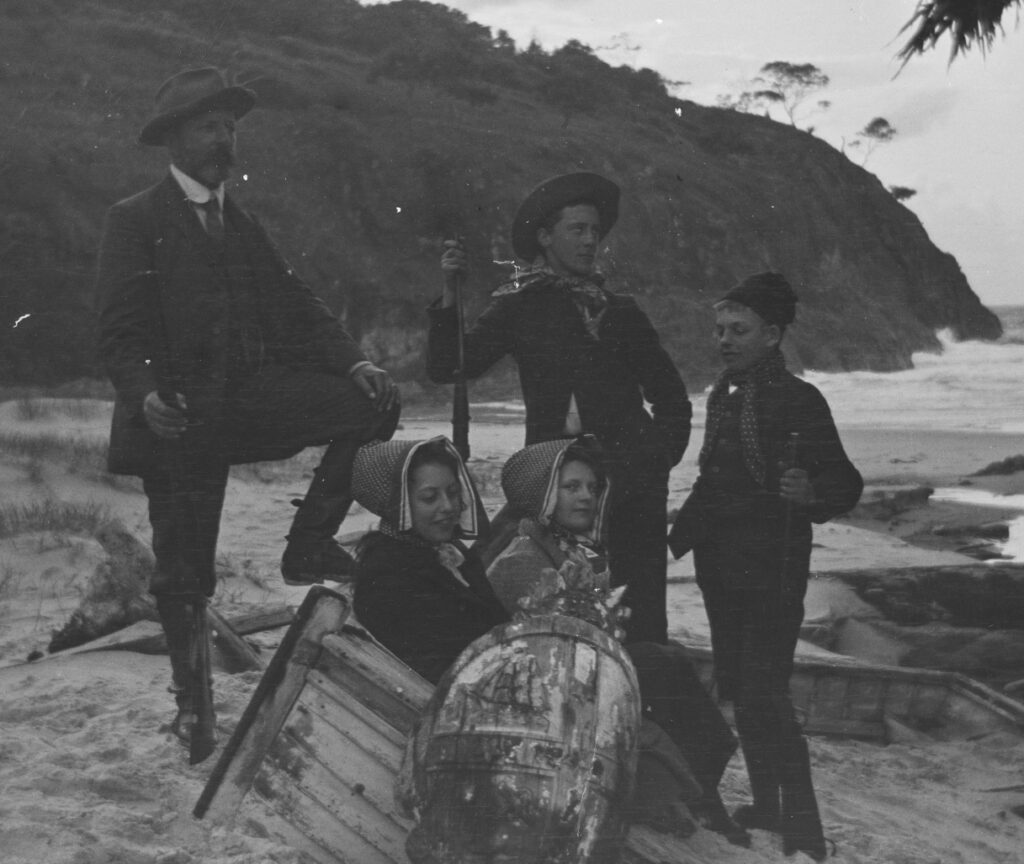
READ MORE: North Stradbroke Island is no stranger to ship wrecks
Hannah’s boss, Colonial Secretary Appel said he viewed the wreck through powerful binoculars after being taken there by his friend Heeb in the company of Hannah.
Local man Thomas Welsby also had an opinion on the legitimacy of Hannah’s claims that there was a wrecked Spanish galleon in the swamp. Welsby published what was essentially a rebuttal to Hannah’s Was it a Galleon article two weeks after it was printed. Welsby disagreed with Hannah’s statement that the shoreline had moved, but he was not against the idea of the possibility of a Spanish wreck. In his article he concludes with the following statement ‘are there no boating men in Southport or Brisbane who are willing and game to explore’.
Another early sighting of the wreck is claimed to have happened in 1888. On 14 January that year two local boys sailed over to Minjerribah from nearby Russell Island to spend several days exploring and duck shooting. While exploring the area the two boys came upon a piece of hewn timber protruding from the sand which they described as carved, but which was too deeply buried for them to remove without a shovel. The boys speculated that the timber might be a ship’s figurehead, but no further investigations were carried out.
When Jeffreys went into the swamp for the first time in search of the ship, he encountered the horrors of the terrain firsthand. He was completely unprepared and underestimated the ferocity of the swamp. Armed with a topographic map, aerial photograph, and a certain blind confidence in the location that Jim Bryce had given him for the location of the ship, Jeffreys set off into the swamp. He was so confident of finding the ship quickly that he didn’t take any water with him. His estimated walk of a mere 800m from the dunes into the swamp turned into an all-day ordeal without finding any sign of a ship.
Jeffreys and his mate ended up with legs cut to ribbons by razor grass … When they finally made it back for a swim their bleeding legs apparently attracted sharks
Jeffreys and his mate ended up with legs cut to ribbons by the razor grass and other vegetation. When they finally made it back to the beach for a swim their bleeding legs apparently attracted sharks which Jeffreys saw circling out beyond the breakers. This first foray into the swamp was a total disaster.
He made several other trips into the swamp, the second time was in 1994 but was plagued by bad weather, mosquitoes, and leeches, followed by another attempt a year later but once again was defeated by the terrible terrain and weather.
Much of the shipwreck myth is based upon the theory that there were at some stage, descendants of the shipwreck survivors living on Minjerribah.
In an article published as a rebuttal to Jeffreys claims of finding a 16th century English coin at the swamp, Quandamooka elder Bob Anderson said that there were plenty of tales of Spanish coins being in people’s possession, but no coins have ever been produced. Anderson believes that the wreck is most likely an old cattle barge.
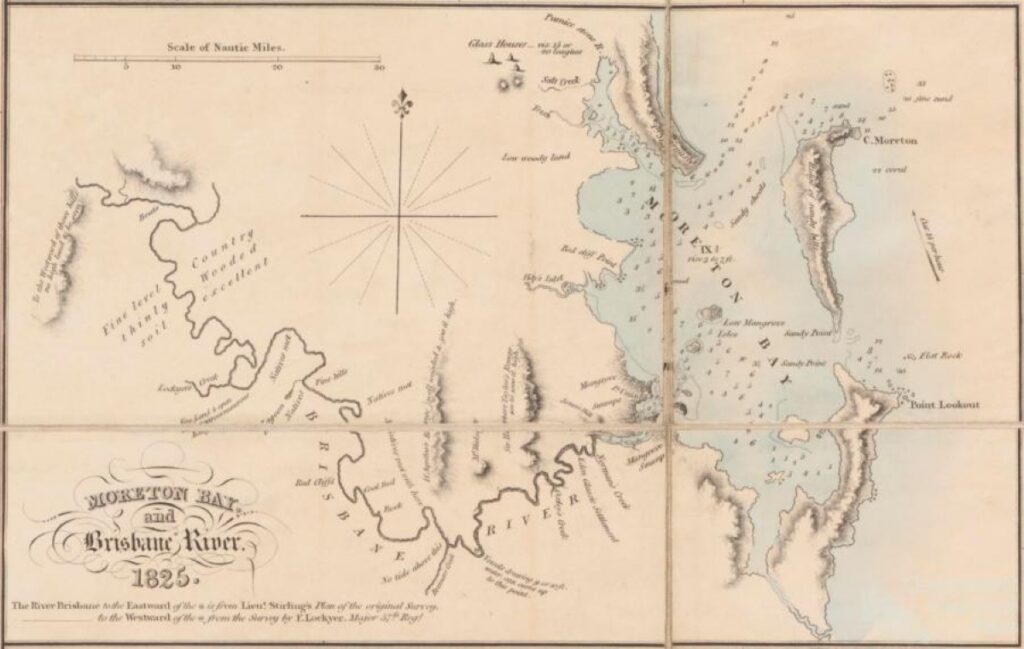
Moreton Bay has seen its fair share of shipwrecks, spanning the 18th and 19th centuries, but the wreck of the galleon is the most tantalising of them all. There are mysteries still to be found in the waters off the Queensland coast, and perhaps in 18 Mile Swamp, and with continued research and technological advancements perhaps one day someone will find that illusive galleon or caravel.
To find more information about some of the stories included in this timeline, search in the library catalogue via the Library Catalogue: Redlands Coast History link or by clicking on the Libraries or Discover Redlands Coast link on the Redland City Council website (redland.qld.gov.au) and following the links to Local History.